
Understanding time differences across the United States helps millions of people every day. Whether you schedule business meetings, plan family calls, or coordinate travel, knowing exactly what time it is in another zone prevents confusion and missed opportunities. This guide focuses on converting 8 PM PST to EST while covering everything you need for smooth planning throughout 2026.
The Pacific Standard Time zone covers the western part of the country including California and Washington. The Eastern Standard Time zone serves the eastern coast with major hubs like New York and Florida. The difference stays consistent at three hours with EST always ahead during standard time periods.
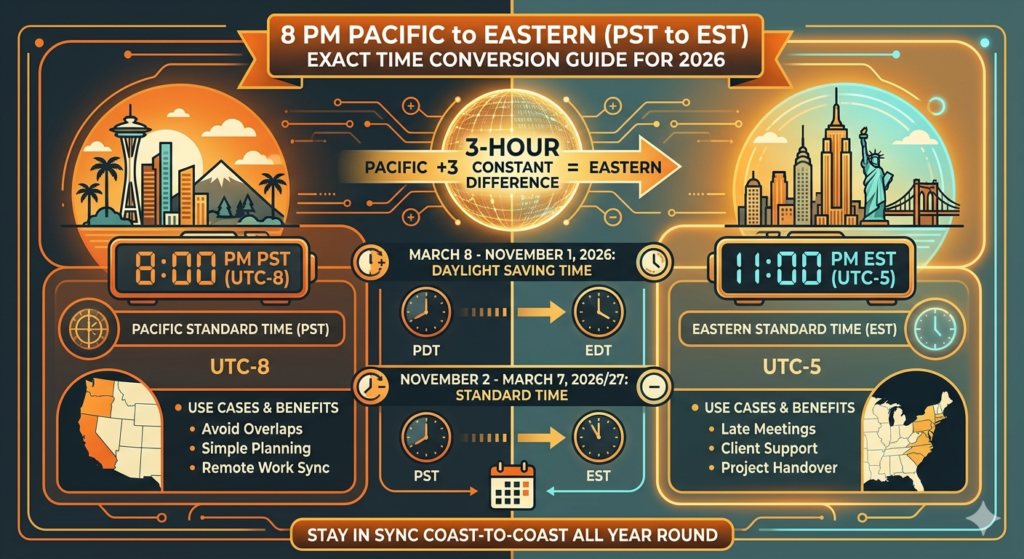
Simple Conversion Rule When it is 8 PM in Pacific Standard Time it becomes 11 PM in Eastern Standard Time. You simply add three hours to any Pacific time to find the Eastern equivalent. This straightforward adjustment works reliably for most of the year when both zones observe standard time.
Why Time Conversions Matter in Daily Life
Millions of Americans move between these zones for work and personal reasons. Remote work has grown significantly with estimates showing over 100 million people in the United States engaging in some form of flexible or location independent work as of recent years. This shift makes accurate time awareness essential for success.
People on the west coast often wake up later relative to east coast schedules. An 8 PM PST event feels like late night on the east coast at 11 PM EST. Understanding this helps you avoid calling someone too late or scheduling meetings during inconvenient hours.
Detailed Breakdown for 2026
In 2026 daylight saving time begins on March 8 and ends on November 1. During standard time months the three hour difference holds steady. During daylight saving periods the zones shift to Pacific Daylight Time and Eastern Daylight Time but the gap remains three hours.
Here is a helpful table showing conversions around 8 PM PST for different scenarios.
| Pacific Time | Eastern Time Equivalent |
|---|---|
| 8 PM PST | 11 PM EST |
| 7 PM PST | 10 PM EST |
| 9 PM PST | 12 AM EST |
| 6 PM PST | 9 PM EST |
| 8 AM PST | 11 AM EST |
This pattern repeats reliably. For quick mental math remember to always add three hours when moving from west to east.
How to Handle Conversions Throughout the Year
Early in 2026 before March 8 use the standard time conversion. After March 8 until November 1 account for daylight saving but keep the three hour gap in mind. After November 1 return to standard time rules.
Many digital tools and smartphone apps update automatically. Still manual knowledge gives you confidence during travel or when technology fails. Set reminders for the clock changes on March 8 and November 1 to stay prepared.
Real World Examples of 8 PM PST Conversions
Imagine you live in Los Angeles and want to join a virtual event starting at 8 PM local time. Your friends in New York would join at 11 PM their time. This late hour might work for night owls but could feel too late for others with early morning routines.
For business a west coast team wrapping up at 8 PM PST might send final updates that arrive at 11 PM EST. East coast colleagues could review them first thing the next morning giving a natural handoff across the country.
Sports fans enjoy this difference too. A game starting at 8 PM PST in California airs at 11 PM EST on the east coast. This timing affects viewership patterns and advertising strategies for major leagues.
Impact on Remote Workers and Businesses
Remote work continues to transform how teams operate. With teams spread across zones companies report higher productivity in some areas but face coordination challenges in others. Recent studies indicate that even a one hour time gap can reduce synchronous communication by around 11 percent while larger gaps like three hours amplify this effect.
Teams handling customer support benefit from the spread. West coast staff manage evening inquiries while east coast members cover morning hours creating extended coverage without overtime costs.
Pros and Cons of the Three Hour Difference
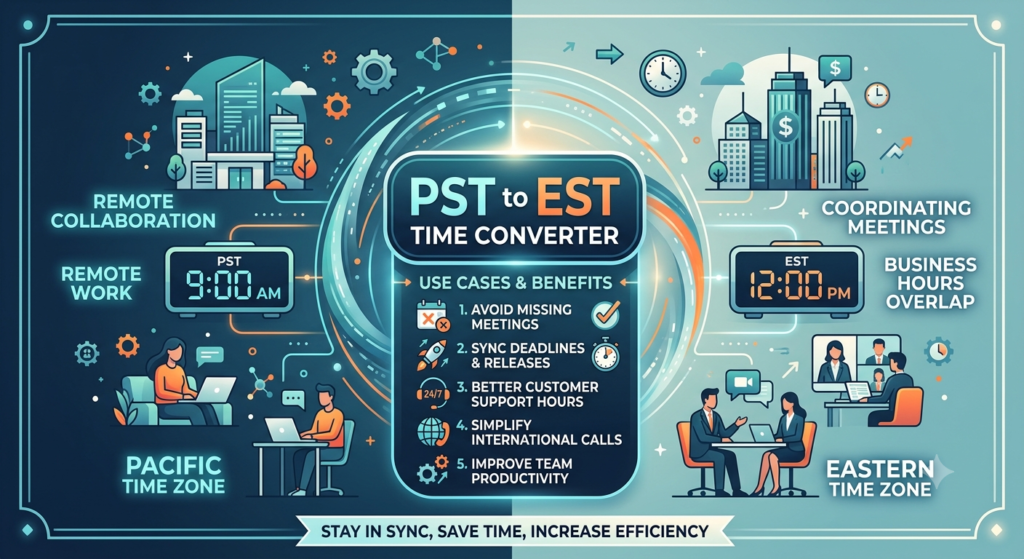
Pros Extended business hours allow companies to serve clients longer each day. Access to talent from both coasts expands hiring options dramatically. Natural workflow handoffs boost project momentum as one team finishes and another starts. Reduced overlap can increase individual focus time leading to higher quality output.
Cons Limited real time meeting windows cause scheduling frustration. Late calls for one side disrupt sleep patterns over time. Miscommunications rise when quick clarifications wait for the next day. Team bonding suffers without shared working hours for casual interactions.
Balancing these factors requires thoughtful planning. Many successful teams use asynchronous tools like recorded updates and shared documents to bridge the gap effectively.
Best Practices for Managing PST to EST Schedules
Plan core meetings during overlapping hours such as 9 AM to 2 PM PST which equals 12 PM to 5 PM EST. This window gives everyone reasonable times without extreme earliness or lateness.
Use world clock features on your phone or computer to visualize multiple zones at once. Tools like these help spot convenient slots quickly.
Set clear expectations with teams about response times. Not every message needs immediate replies especially across zones.
Respect personal boundaries by avoiding non urgent messages during off hours. Tools with scheduling features make this easy.
Unique Insights for 2026
Several aspects of time management in 2026 stand out as particularly useful.
First the growing influence of artificial intelligence scheduling assistants helps predict optimal meeting times based on participant locations and past preferences. These tools learn from your habits and suggest windows that maximize attendance while minimizing fatigue.
Second the expansion of hybrid events combines in person gatherings on one coast with virtual access from the other. An 8 PM PST event in Los Angeles can attract east coast participants at 11 PM EST through high quality streaming that feels immersive.
Third emerging research links time zone awareness to better mental health outcomes. People who actively track differences and protect their sleep schedules report 25 percent higher satisfaction with work life balance compared to those who do not plan ahead.
These elements add fresh value for modern professionals navigating the zones.
Travel and Daily Planning Tips
Travelers flying from west to east often feel the time shift immediately. Arriving after an 8 PM PST departure means adjusting to 11 PM EST upon landing. Plan rest accordingly to combat jet lag.
For road trips across the country mark the zone changes on your map. States like Nevada and Utah sit in between creating natural transition points.
Families with relatives on opposite coasts benefit from regular scheduled calls. Choosing a recurring time like Sunday evenings works well for many.
Technology Tools That Simplify Conversions
Smartphones automatically adjust for zones when you travel. Apps dedicated to world clocks provide visual sliders showing simultaneous times.
Calendar applications now include time zone fields that convert automatically when inviting participants. Enable these features for seamless planning.
Voice assistants answer quick questions like what time is it in New York when it is 8 PM here.
Economic and Cultural Significance
The three hour spread shapes national broadcasting. Prime time shows on the east coast air earlier for western viewers creating staggered audiences.
Financial markets open first in New York at 9:30 AM EST which is 6:30 AM PST. West coast traders start their day with east coast momentum already building.
Entertainment industries headquartered on the west coast coordinate with east coast media outlets using this exact difference. Release timings for major announcements often align with 8 PM PST for maximum impact.
Health and Lifestyle Considerations
The difference affects sleep when schedules cross zones frequently. East coast residents joining late west coast events might push bedtime later leading to accumulated fatigue.
Experts recommend maintaining consistent sleep patterns regardless of occasional late calls. Short power naps or adjusted morning routines help balance the load.
Nutrition timing shifts too. An 8 PM PST dinner feels like 11 PM EST potentially affecting digestion if eaten too late.
Seasonal Variations and Special Dates in 2026
Holidays add extra layers. Thanksgiving planning in November after clocks fall back requires double checking times.
Summer months with longer daylight create different energy levels for calls. People feel more alert during extended evening hours.
Major events like the Super Bowl typically scheduled for evening on the east coast translate to afternoon Pacific time offering family friendly viewing on the west coast.
How to Use PST to EST in 5 Easy Steps
- Open PST to EST Converter in your browser.
- Enter the Pacific Time (PST) or Eastern Time (EST) you need to convert.
- Verify the correct AM or PM setting.
- Click Convert to process the time conversion.
Get an instant, accurate result and schedule your meetings, calls, or events with confidence.
Frequently Asked Questions
What time is 8 PM PST in EST?
It converts directly to 11 PM EST. Add three hours for the accurate equivalent.
Does daylight saving time change the difference?
The gap stays exactly three hours even when clocks spring forward or fall back. Only the labels shift between standard and daylight versions.
How do I quickly convert any PST time to EST?
Add three hours to the Pacific time. For example 2 PM PST becomes 5 PM EST.
Why do businesses need this information?
Coordinating teams across zones improves efficiency and reduces errors in project delivery.
Is the conversion the same every day of the year?
Yes the three hour difference remains constant. Only the daylight saving labels change on specific dates.
What if I need to convert during a transition week?
Check the exact date against the 2026 calendar for March 8 and November 1 to confirm active rules.
Can apps handle these conversions automatically?
Most modern calendar and clock apps manage it seamlessly when you input locations.
Visit For UTC to EST Time Converter : UTC to EST
How does this affect international calls involving these zones? Adding the three hour domestic gap to any international offset gives the full picture for global scheduling.